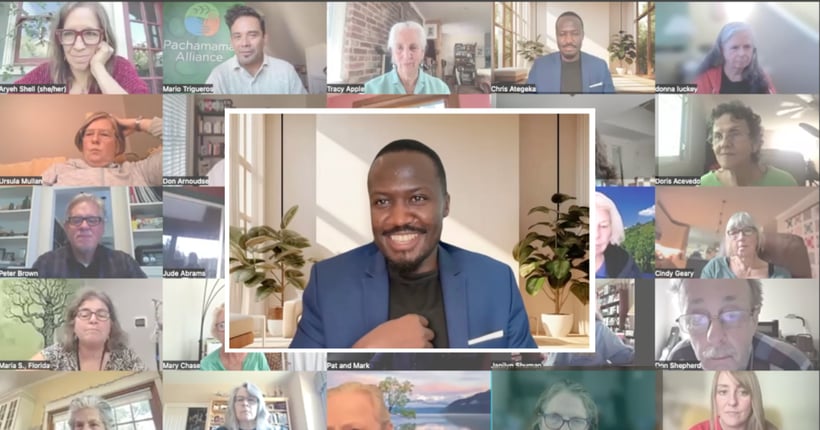
 In a world built for machines, Chris Ategeka calls us back to what makes us human.
Chris was born in rural Uganda, lost his parents young, and grew up caring for his five younger siblings—learning early what love asks of us. Today, he is an engineer, author, and father whose work reminds us that dignity, presence, and belonging are not luxuries, but necessities of our time.
His conversation at Resilience and Possibility In These Times invited a return to what the soul knows.
The Quiet Ache
 There is something missing.
You might feel it at 11 p.m. at night when sleep won’t come, when you reach for your phone—scrolling, swiping, searching for something that does not reside in that glow. You might feel it in the endless distractions that promise relief but deliver only emptiness.
Chris names it plainly: “Beneath all that noise, there’s this quiet ache like it’s whispering, like something is missing.”
He reminds us that the whisper isn’t weakness—it’s wisdom. It’s the part of us that remembers what it means to be human: to feel, to love deeply, to belong.
“We need to put back the word human in humanity,” he says. “We need to put the word commune in community. And quite frankly, we need our aliveness back.”
At the heart of this matter is a cultural malaise. When capitalism and technology conspire to replace ritual with routine and connection with consumption, something sacred is exiled. The whisper Chris speaks of is the voice of Mother Nature calling us home.
Crisis as the Portal to Interdependence
 The crises surrounding us—ecological, political, spiritual—may hold within them the medicine that dissolves the illusion of separation.
Sharing vulnerably from his own lived experiences, Chris told a story about strangers who sent him a few dollars to Africa without expectations of anything in return, acting from,
“that link to the common interdependence of our planet and our humanity.”
They never met him. He never met them. Yet their care created the conditions for his life to unfold differently.
He described himself as,
“a product of someone else’s generosity… they just wanted to do something good, what’s right for the world.”
Through this story, Chris reframed crisis as not only a catastrophe but an invitation. When the industrial systems that promise control begin to crumble, the deeper web of generosity that has always held us becomes visible again. Breakdown teaches humility. Humility ripens into gratitude. And dependence—so often feared or shamed—becomes a reminder of our belonging, the living soil from which reciprocity grows.
Grief as Love Looking for a Place to Go
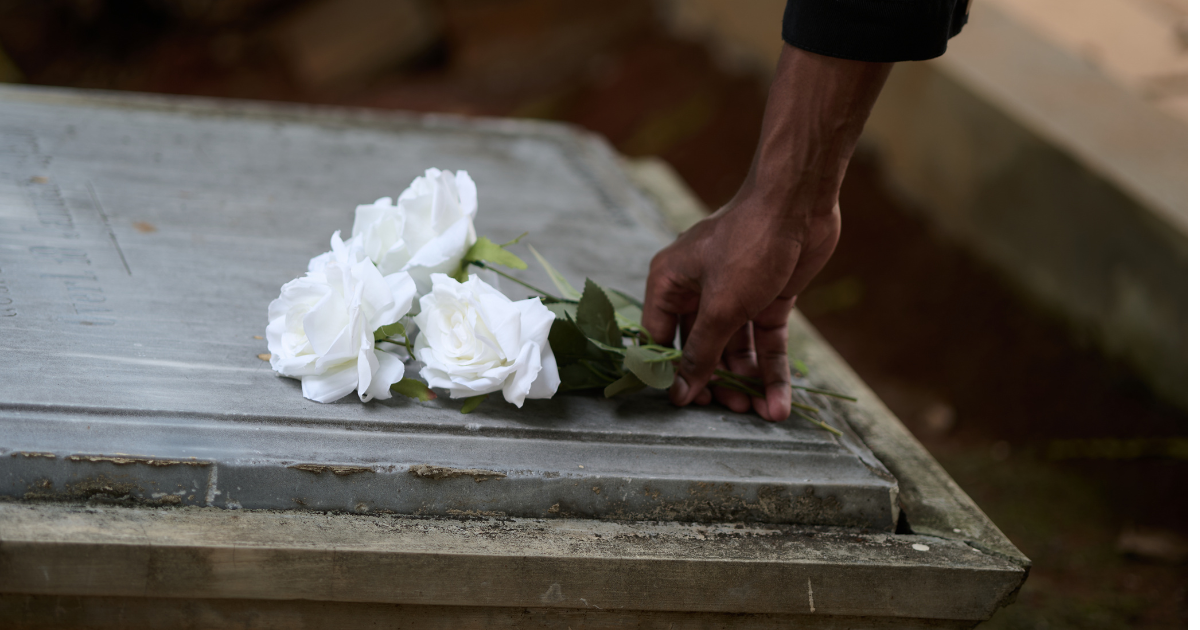 Chris lost both his parents when he was young and became a parent himself to five younger siblings. He grew up in the crucible of loss and in the quiet, persistent presence of love that refused to disappear.
He knows grief intimately. And he knows it as love, too.
"Grief is love trying to find a place to go…you're in so much pain because the old vessel where this love used to be is not any longer. So you have to find a new place.”
In his Ugandan village, grief was communal.
“In my culture… your community is your therapist,” he shares.
When someone died, the whole village gathered for days, sitting with the body, metabolizing loss together before burial.
But in the industrialized world,
“a person lives a fabulous life… they might have a wonderful mansion and they’re in it by themselves. There’s no single person you can actually call at 3 a.m. when life gets hard.”
When grief has no communal vessel, it metastasizes. The alienation bred by capitalism leaves many cut off from meaning, and that loss can masquerade as rage, nationalism, or the search for someone to blame. Recognizing this shared alienation doesn’t excuse harm, but it’s an important step towards repair.
If grief is love seeking form, then ritual is the path that gives it direction. It is how we make space for sorrow to move, and for love to find its way home again.
Ritual as Resistance, Presence as Practice
 Chris’s day begins at six every morning—what he calls "chicken clock" time, named for the roosters that woke his Ugandan village. He has a morning ritual and invites everyone to develop their own as a way to stay grounded and better face these times. One of his is simple rituals: making his bed.
"Even if the day goes terribly wrong, I've accomplished something. And also if the day goes terribly wrong, I have an amazing well-made bed that I could just fall into and fall asleep.”
Ritual steadies us so we can face reality without fragmenting.
Chris’s invitation is to commit to a practice of your own. A walk without your phone. Three minutes of stillness before the day begins. Far from simple acts of self-indulgence, ritual is an act of resistance to the forces that would have us numb.
Ritual is not escape; it’s an anchor to what is real.
A Heart Scared by Time
Chris closed the conversation with a poem. In it, he wrote:
What survives the storms, what outlasts the illusions, what remains when the noise fades is not perfection, or certainty, or even understanding.
It is presence.
It is the quiet courage to show up to love again, to hope again, to build again, even with trembling hands, scared.
Maybe that’s what a heart made of time really is:
Not a heart that avoids breaking, but a heart that learns to hold the cracks as proof it lived fully.
To live this way is to align with life’s sacred purpose—to generate more life. Let’s do it with presence, courage, and care.
Watch the Recording