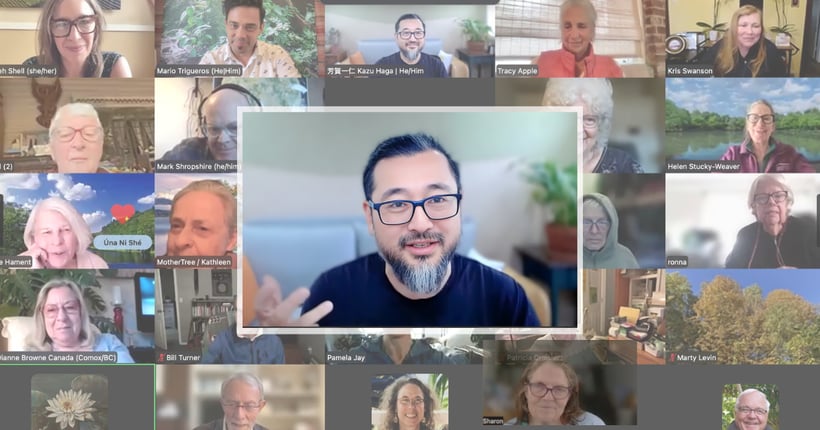
There are times in Resilience and Possibility when someone speaks truth in a way that ripples through the whole field and pierces straight to the heart. Listening to Kazu Haga was full of those moments. As an author, Buddhist practitioner, and teacher of nonviolence as a path to sacred relationship, his wisdom opened a portal right into the heart of the universe. If we want to heal our own pain, and the pain we are living through as a society, then we must learn to lead with that kind of broken-hearted courage.
The Power of Broken-Hearted Courage

“Every time I've gone through any healing, it was because vulnerability was present,” he said. “I am not able to heal any of my own trauma if I'm not able to have the fierceness and the courage to go to those places that are deeply vulnerable.”
Changing the world, he said, asks more of us than new policies or protests. While those are critical components of social change, we also need to heal the trauma lodged in the body of humanity itself.
And yet, so much of modern culture teaches us the opposite. We’re conditioned to armor up, to rely on intellect and strategy, to brace ourselves against the world or defend against the “other. Activism is often approached with an attitude of “us vs. them.”
Kazu invites us to dissolve those binaries, simply because they don’t exist inside the reality of interdependence. His most recent book, Fierce Vulnerability, explores how to defend what is sacred without closing our hearts.
The Myth of Separation

One of the most resonant threads was Kazu’s reflection on the illusion of separation as a root cause of collective trauma. When we begin to believe we are alone—separate from each other, from the Earth, from the living Cosmos—something in us fractures.
Instead of seeing violence and systems of oppression as political failures, or the result of “bad people doing bad things,” Kazu frames injustice as a manifestation of collective, unintegrated trauma. The enslavement of African peoples, the genocide of Indigenous nations, and the ongoing desecration of Earth are not separate historical events; they are symptoms of collective trauma that continues to shape our behavior today.
“The delusion that says I am separate from you,” he said, “is the same delusion of supremacy that says I can dominate the Earth and win.”
Interdependence, he said, is as real a law of the universe as gravity. And in an interdependent universe, there is no such thing as personal healing.
“We live in an interdependent and fractal universe,” Kazu said, “so what happens in our individual bodies happens at every scale—in our families, our communities, our nations.”
The patterns we see of individuals lashing out when they feel scared or hurt play out at the scale of nations. If causing harm is a pattern of trauma, then social justice requires more than resistance. It requires listening, skillful and compassionate tending, and an intention to heal.
Direct Action as Ceremony

The transformation and crises unfolding now— ecological, cultural, spiritual— are far too vast and complex for our minds and intellect alone to navigate. If healing is our intention, then we must learn to bring different energies into our movements. Kazu spoke about lessons from Standing Rock, where elders reminded water protectors that going into direct action was the same as entering a ceremony.
Imagine preparing for a protest the way we prepare for a ceremony: slowing down, purifying our attention and turning down the noise of our lives so we can listen deeply and show up differently. The energy of ceremony transforms direct action from an oppositional stance to an act of love and relationship. It shifts the field from one of winning to one of prayer.
This reframing, Kazu offered, doesn’t ignore the need for resistance.
“We may still need to use our bodies to stop a pipeline. But can we do it in a way that opens up the conversations our country has avoided for centuries—about grief, about repair, about belonging?”
What if activism was considered a form of devotion? What if a blockade, a march, or a rally were entered not as a battle to “shut it down,” but as a sacred space to “open it up?” To open up dialogue, to open the heart, to open the possibility of collective healing.
What would change if we brought this level of reverence, presence, and inner preparation into our movement spaces? What becomes possible if we show up with an open broken heart rather than with righteous anger? Could we create a new way, or remember an ancient way, of being in relationship with the Earth and each other?
This kind of presence or spiritual activism, he said, is not new. It’s remembering who we are and where we come from.
“We are not humans trying to save the Earth. We are the Earth trying to save itself through us.”
— Ailton Krenak, Indigenous leader and environmental activist
Leading with compassion and surrender
 Kazu shared that in the Fierce Vulnerability Network, organizers have been experimenting with reimagining direct actions as public grief rituals or other creative approaches to open things up. Saying to those we don’t agree with, “We are scared. We are grieving. We want to find a way through this, together.”
Not because we expect vulnerability or compassion to magically change oppressive systems or people, but because it changes us. It expands the field. It restores us to our interdependence.
A sense of awe for the mystery also ran through his reflections. The transformations happening on Earth right now are not only being driven by us. Earth is the true change agent. He invited us into what he called the “liberation of surrender,” not surrender as in giving up, but surrender as letting go of the illusion of control.
“...there is so much of this moment that is about accepting the grandeur and the mystery of the cosmos, and just accepting that we're not going to have all the answers, but if we quiet down and listen deeply enough, maybe we'll hear that subtle voice that tells us the one tiny step that we need to take, and to trust that if we take that one tiny step and keep listening, we will figure out our way forward.”
Listening to Kazu brought forth both the tenderness and the bravery required for living in this moment of profound change on planet Earth. We are being asked to change everything, to slow down, to practice fierce vulnerability, to breathe together, to lead with heartbreak, to listen for what the river might be saying. And perhaps most importantly: to remember we are not alone. To remember that we belong inside of a magnificent and radically interdependent, alive, and evolving Cosmos.
An Invitation Into Practice
You are invited to join and participate in the upcoming 3-month Fierce Vulnerability Kinship Lab, starting in March 2026! The Lab will include teachers like Francis Weller and Kyra Jewel Lingo, and is an invitation for people to build communities of practice—not just talking about these ideas, but experimenting and living them together.
Because the world we long for will be built by hearts willing to break open. By bodies willing to turn toward what hurts. By communities learning to come back into the right relationship with the Earth, and the rhythms of life again.
Watch the Recording