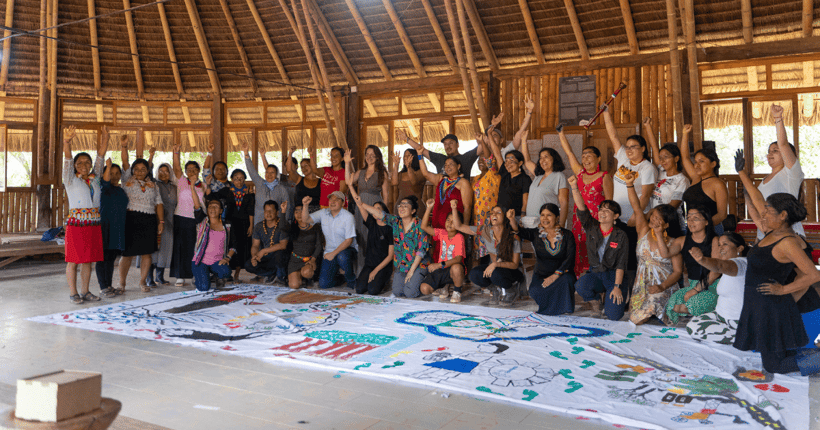
 2025 was a year of profound challenges for Fundación Pachamama and for the Ecuadorian Amazon. It was also a year of concrete, ground-up progress led by Indigenous communities and local actors. At Fundación Pachamama, we reaffirm the conviction that guides all our work: the most enduring solutions to the climate, social, and environmental crises in the Amazon come from the forest and from its people. Across our programs, we achieved tangible impacts that strengthen life, protect forests, and advance the self-determination of Indigenous communities.
Strengthening Forest Economies
Through our Forest Economies program, we advanced sustainable production alternatives rooted in regeneration and territorial stewardship. In 2025, we registered 938 agroforestry systems covering 697 hectares, strengthened eight Amazonian value chains, and graduated 242 participants from the School of Bioeconomy. These efforts contributed to milestones such as the export of 10 tons of morete pulp and the generation of trade flows benefiting thousands of people across the Amazon.
Through the Regional Bioeconomy Hub and the PachaEmprende program, we provided targeted technical assistance to 45 initiatives in finance, marketing, and innovation. As a result, 38 bio-enterprises implemented technological improvements to automate payments, 7 secured international certifications or recognitions, and 10 new prototypes of processed beverages were developed—expanding market access while upholding commitments to zero deforestation and fair trade. In addition, more than 370 people received training in financial management, supported by a network of 50 private-sector mentors.
Caring for Life from the Beginning
Through the Ikiama Nukuri program, we strengthened Indigenous maternal and child health by training 58 Achuar and Shuar health promoters, assisting 87 births, and distributing more than 2,700 culturally appropriate birthing kits. We also continued to recognize the essential role of community midwives through financial incentives, which since 2013 have totaled more than USD $226,000.
Protecting Forests and Territory
Through our Forests and Territory program, we protected 33,700 hectares of critical biodiversity in the lower Pastaza River basin, benefiting more than 1,100 people in Achuar communities. By training 21 community monitors, we implemented biocultural monitoring systems that documented 58 species—including jaguar, tapir, and bush dog—key indicators of healthy, intact ecosystems.
Advancing Human Rights and the Rights of Nature
Our Human Rights and Rights of Nature program supported historic advances, including the ruling in the Tagaeri Taromenane case, progress in the implementating the Escazú Agreement in Pastaza, and the launch of the Escazú Observatory. We also strengthened Indigenous women’s and youth leadership through training processes, diploma programs, and the First Meeting of Women Lawyers Defending the Rainforest.
Ecotourism as a Pathway to Well-Being
Through the Ecotourism and Human Footprint program, we demonstrated that community-led tourism can support conservation, cultural vitality, and well-being. Kapawi Ecolodge received the Ibero-American Award for Social and Sustainable Tourism. We developed a methodology to measure the carbon footprint of tourist transportation, welcomed engaged visitors through Pachamama Journeys, strengthened access to safe water in Achuar communities with a water purification system, and began developing an Achuar-English translation app as an intercultural bridge.
Bringing the Amazon to Global Climate Spaces
Through our Climate Finance program, we elevated Amazonian voices in global decision-making spaces, including New York Climate Week, the World Economic Forum, the Summit of Amazonian Presidents (ACTO), and processes leading up to COP30. We promoted innovative bioregional financing mechanisms while strengthening Indigenous and youth leadership within the international climate agenda.
This collective impact would not be possible without the commitment of our partner communities, donors, and strategic allies. In 2026, we will continue building solutions from the Amazon—for life, for climate, and for the future of the planet.