 This post was written by Aryeh Shell, Pachamama Alliance staff member.
What does it mean to belong to a place? Bioregionalism invites us to hold this inquiry and put it into practice in the way that we tend relationships, make decisions, and take responsibility for its well-being. I carried this question with me to the 11th Turtle Island Bioregional Congress (TIBC), where I joined nearly 270 people at Camp Cedar Ridge in Vernonia, Oregon. We gathered in the Cascadia bioregion, on the ancestral lands of the Confederated Tribes of Grand Ronde and Siletz Indians, surrounded by Douglas firs and alders, salmon and crawdads, hawks, crows, and blue jays, knowing that the Congress included far more participants than just the human ones who had registered.
The bioregional movement invites us to reorganize our lives around the places and living systems that sustain us, meaning our watersheds, forests, ecosystems and communities. The Congress first convened in 1984 and met annually in different bioregions around Turtle Island for 10 years. This 11th Congress took place after a 17-year pause, co-organized by Pachamama Alliance Vision Keeper, Karie Crisp, with the intention to strengthen a resurging wave of place-based organizing for community resilience, Indigenous leadership, local self-governance, ecological regeneration, and a flourishing future for all life.
I came representing Pachamama Alliance because this movement feels deeply kindred to something we are cultivating: a mycelial network of Kinship Circles—small communities of practice and collective action where people strengthen kinship with one another, with the living Earth, and with future generations. I came to learn, build relationships, and explore how these movements might cross-pollinate.
At the heart of the Congress was an inquiry into what it means to come back into the right relationship with place, with the Indigenous peoples who have cared for these lands, and with one another. An Intertribal Council representing 22 Indigenous nations was formed prior to the gathering to provide leadership and guidance throughout the Congress.
The opening ceremony began with asking permission of Greg Archuleta of the Confederated Tribes of Grande Ronde to conduct our activities on their lands. Archuleta welcomed the Congress and said it was important that TIBC reached out to the local Tribal community, giving them voice into the process and the opportunity to work in collaboration. He closed with a prayer song in the local language of Chinuk Wawa.
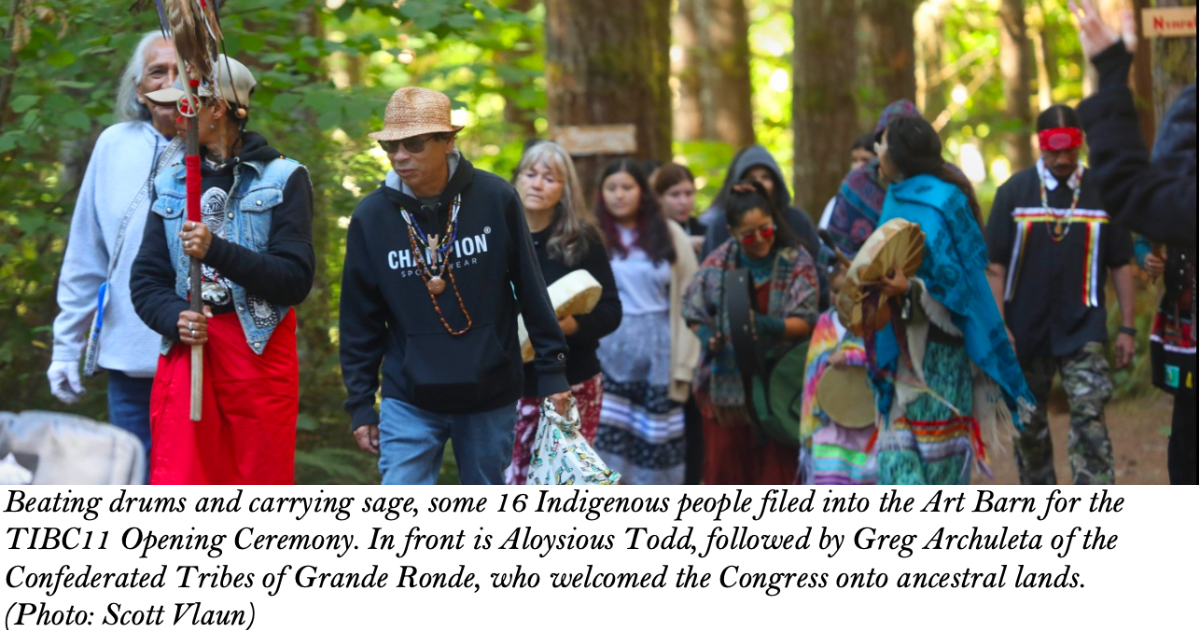
Photo credit: Voice of the Turtle, September 19, 2026
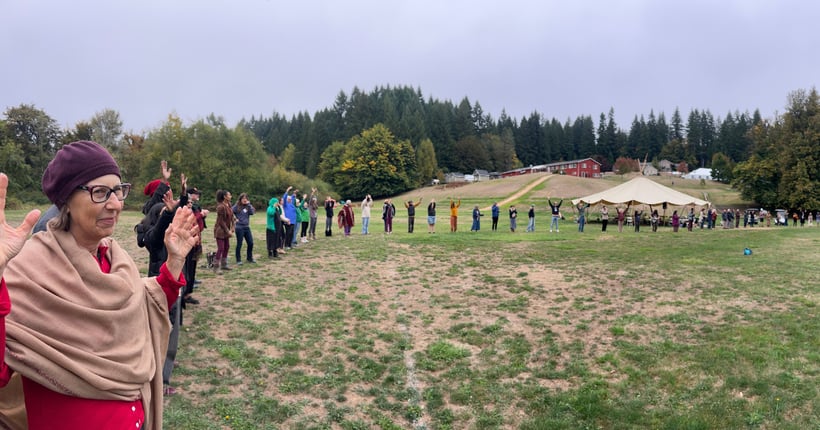
On Wednesday, we gathered for a Ribbon Ceremony for the purpose of honoring and remembering Missing and Murdered Indigenous Relatives, inclusive of women, men, Two-Spirit and nonbinary folk. Stories and prayers were shared and participants were given a pin with multi-colored ribbons and, following the protocol, we pinned it behind the left shoulder of the person in front of us as we stood in circle, representing how our relatives are behind us, and still present with us to carry on the memory of all those who have been killed or lost.
We also lived into this intention of building trust and reestablishing right relations through a journey of rupture and repair. The Congress attempted to revive a long-standing tradition in which humans are asked in a ritual way to become “InterSpecies Intermediaries” during the daily Convergences and hold the perspectives of the four-leggeds, winged-ones, swimming ones and the plants and trees. Their task was to listen to the human proceedings with an ear to their more-than-human constituents and if their needs are being neglected or violated, then to make it known through nonverbal interventions, so that the humans could course correct into a more inclusive way forward.
A misunderstanding arose in which a woman, representing a winged one, wore a gifted shawl by request of a Diné matriarch, who was present at the gathering, for this particular practice. This context was unknown at first and the shawl appeared to many as traditional regalia, which surfaced pain, assumptions, and the deeper wounds of cultural appropriation and centuries of colonization. What followed was deeply instructive. Rather than allowing the conflict to fracture the gathering, the people impacted entered into multiple group processes and eventually a collective peacemaking circle where hurt, grief, intention, and impact could be named and held together.
It reminded me that building a regenerative future isn’t only about developing new systems of governance or about remembering that we are interdependent. It requires developing our capacity to stay in relationship when things get hard—to slow down, listen, and repair.
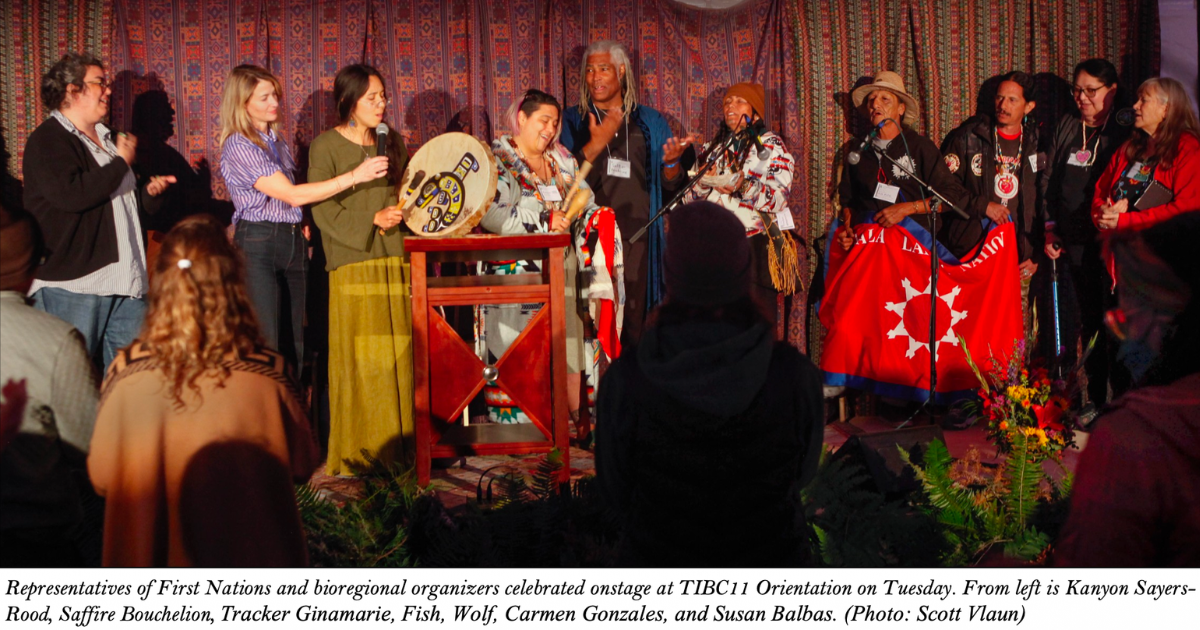
Photo credit: Voice of the Turtle, September 19, 2026
Throughout the four days, the Congress used participatory processes to allow priorities and strategies to emerge directly from the participants who gathered. Bioregional groups met to determine ways of acting together and supporting each other's projects upon return. Working groups explored everything from resilience hubs, bioregional mapping and governance, land decommodification, regenerative economics, Rights of Nature, and watershed restoration to seed security, forest stewardship, transforming education systems, strengthening kinship and the role of art and ritual in tending grief and trauma. These conversations will help inform and shape a Bioregional Action Toolkit, supporting people to organize, tend, and care for their own places.
One particularly inspiring example came from colleagues in Mexico, who shared about a class action lawsuit brought by 20 cross-sector bioregional groups against two government ministers, the Ministers of Agriculture and the Environment, as well as companies such as Monsanto, Syngenta, Dow, and DuPont. The lawsuit calls for an end to the commercial planting and importation of low-cost GMO corn crops across the country. They also shared their decades of work organizing youth, elders, and communities across 400 hundred towns to protect the Water Forest of Central Mexico, where four watersheds originate. Their stories embodied what becomes possible in a bioregional model of relationship when people understand themselves not just as residents within politically defined boundaries, but as people responsible to a shared living system.
I also had the honor of co-hosting a Council of All Beings, a practice developed by deep ecologists Joanna Macy and John Seed. People were invited to be chosen by a more-than-human Being and speak in a Council to the impacts they are experiencing in these times. We heard from Turkey Vulture, Brown Trout, Condor, Blackberry, Usnea, Alder, Dragonfly, Sword Fern, Orb Weaver, Rogue River, Rock Creek, Sun, Raven and Cascade Volcano who all spoke to themes of habitat destruction, resource scarcity and increased threats to their families and kin. Participants were invited at various points to reinhabit their human forms, sit in the center, and also receive the gifts and guidance offered by the Beings to find their way back into the web and act courageously in service to life.
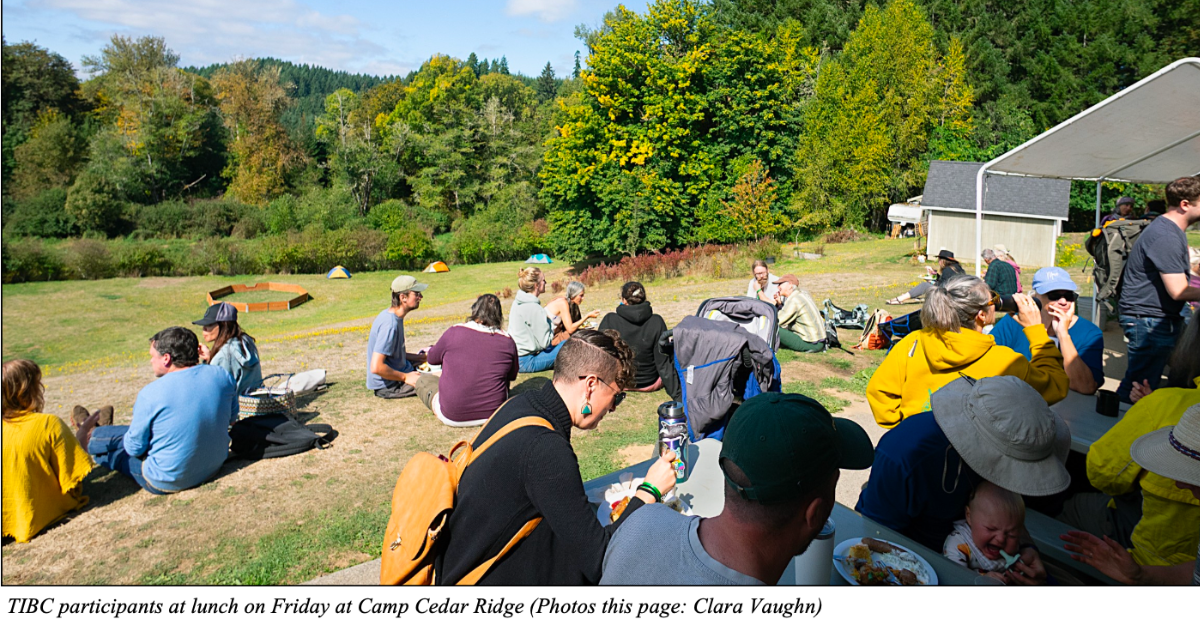
Photo credit: Voice of the Turtle, September 19, 2026
The four days ended with a wild and raucous InterSpecies Ball, dancing together under the trees and stars. I left with new connections, ideas, inspiration, and a lot of humility. If there was one lesson weaving through it all, it was that the work of building an environmentally sustainable, socially just, and spiritually fulfilling human presence on this planet is inseparable from the work of relationship. We cannot build a life-sustaining future without healing the wounds of colonization, separation and supremacy, learning again how to belong to a place, and practicing how to stay in relationship with one another through complexity and conflict.
We belong to each other and we all belong to this breathing Earth. This belonging invites us into a responsibility to slow down, drop into the heart and move together at the speed of trust.